
Black History Month Trivia – Week 3
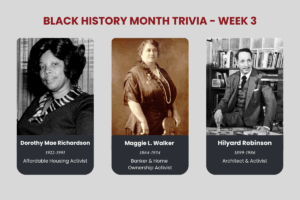
Dorothy Mae Richardson (1922-1991)
Dorothy Mae Richardson pioneered community-based affordable housing in 1960s Pittsburgh when she refused to let her neighborhood be demolished under urban renewal. Instead of accepting displacement, she organized her neighbors, persuaded 16 banks to invest in redlined communities, and championed the idea that struggling neighborhoods could be restored by fixing homes rather than tearing them down. Her efforts led to the creation of Neighborhood Housing Services in 1968 — the first “NeighborWorks” organization — a model later replicated in hundreds of cities. In 1978, Congress established NeighborWorks America based on her resident-led approach, helping shift national housing policy toward preservation, community empowerment, and affordable homeownership. MORE ABOUT DOROTHY MAE RICHARDSON
Maggie L. Walker (1864-1934)
Maggie Lena Walker advanced affordable housing through economic empowerment. As the first African American woman to charter a bank in the United States, she founded the St. Luke Penny Savings Bank (Richmond, VA) in 1903, providing Black families access to loans and mortgages. Her philosophy—”Let us put our money together; let us use our money”—created pathways for Black homeownership and property investment. The bank financed over 600 home and business loans, helping establish Richmond’s Jackson Ward as a thriving Black business and residential community. Walker proved that financial inclusion was foundational to housing access and community stability. MORE ABOUT MAGGIE L. WALKER
Hilyard Robinson (1899-1986)
Washington, D.C. architect Hilyard Robinson understood that affordable housing could be a powerful driver of social progress. Robinson designed the historic Langston Terrace Dwellings and Aberdeen Gardens, groundbreaking public housing communities for Black workers and their families during an era of segregation and severe housing discrimination. Langston Terrace featured green spaces, playgrounds, and artwork that enhanced daily life, while Aberdeen Gardens included garden plots, a school, and a commercial center to support resident growth. His thoughtfully designed communities promoted dignity, self-sufficiency, and economic mobility—a legacy so significant that both are now listed on the National Register of Historic Places. MORE ABOUT HILYARD ROBINSON
Leave a Reply
Want to join the discussion?Feel free to contribute!